Heyhey, it’s high time to get historical again. Enough of that giant robot stuff for now. Let’s talk Tilly.
Tilly’s Very Bad Day is a set of rules for the Thirty Years War (but they also work for the 80 Years War, the English civil war, etc. as well) written by Steven Thomas.

If you are a historically inclined wargamer, use the internet and read the English language, chances are very high you read Mr.Thomas’ long-running (and in my opinion excellent) blog: Steve’s Balagan. I love a blog. It’s proper internetting, isn’t it. And by the looks of it, proper internetting is direly needed nowadays. Due to the miracle of generative AI the Dead Internet thing might actually become somewhat of an actual thing even though I never subscribed to that theory. Might happen though. So between pointless, lifeless and instantly-vanishing social media posts and AI-generated non-information (I’m sure that several horrible people already came up with a term like ‘non-tent’ for that sort of stuff), we need blogs, featuring written words of merit or at least any information stored and accessible at any point. This one here isn’t a great example since it’s more just a diary of our wargaming stuff, but there’s useful blogs and websites as well. 😛

Steve’s Balagan is a prime example of a useful website. Researching several different topics led me to this blog over and over, and reading posting, be they from 2020, 2016 or 2010, is enlightening. Highly recommended.
In 2019, the first version of Tilly’s Very Bad Day was put online for free. The goal was to create a set of fast-play rules for battles sat during the Thirty Years War. Being particularly interested in this period and being a fan of the blog, these rules have been on my to-play list for many years. When a few weeks ago Cpt.Shandy messaged me, declaring that we should play something historical again, the time had come.
The Book
Well, it’s a PDF (free, available here). There used to be a printed version available though Lulu, but apparently it isn’t any more. Over 2019 and 2020 a few changes were implemented in the rules, but not in a while, and the rules can be regarded as finished. So if you want to get the PDF printed, it seems to be safe to do so.
70 pages, 44 thereof being the rules, the rest is introduction, table of contents, advanced rules, tokens for printing and cutting out and so on.
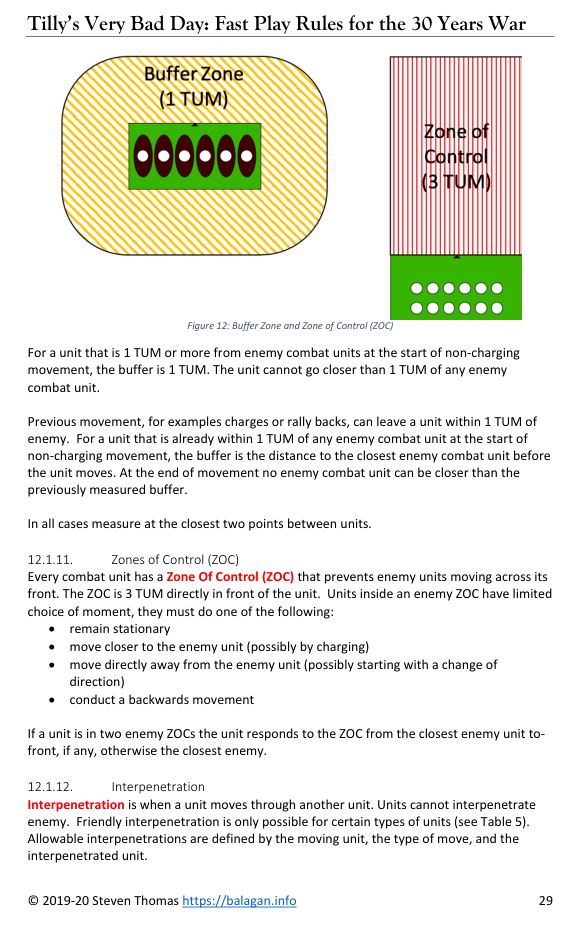
The text isn’t too dense, game terms are highlit in red. There are several Designer’s Notes strewn in as well as many game examples with diagrams to cover and clarify game situations.
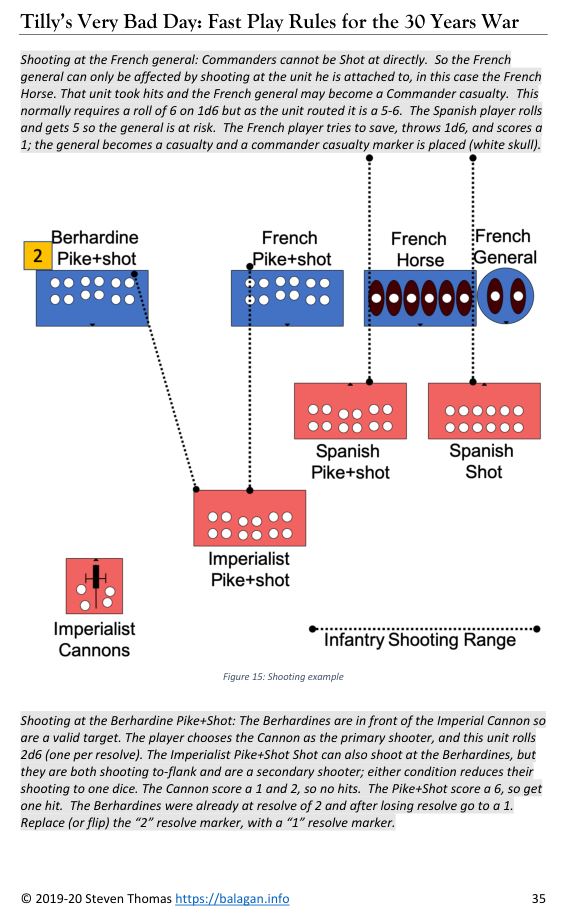
The rules design strikes me as being of that lovely sort where I feel like I can trust the author to be knowledgable about the period first and then a lot of thought was put into how to make that into a very playable game.
What Do I Need to Play?
Miniatures (any size or scale), a gaming table (from 3′ by 3′ up to the size of a football field), measuring tape, a few six-sided dice (usually three to six will be rolled at once) and some tokens to depict shooting, movement, charges and number of ‘hits’ on each unit.

The Rules
You can use any size of figures you want, everything in the game is measured in TUM (Tilly Unit of Measure), which equals half a unit’s frontage.

Kinda like in Twilight of Divine Right. It’s made for big unit bases, no base removal. Hence the ‘hit’ tokens required. There are no formation changes, all units use the same base footprint.
Unit Types
There are eight different types of units:
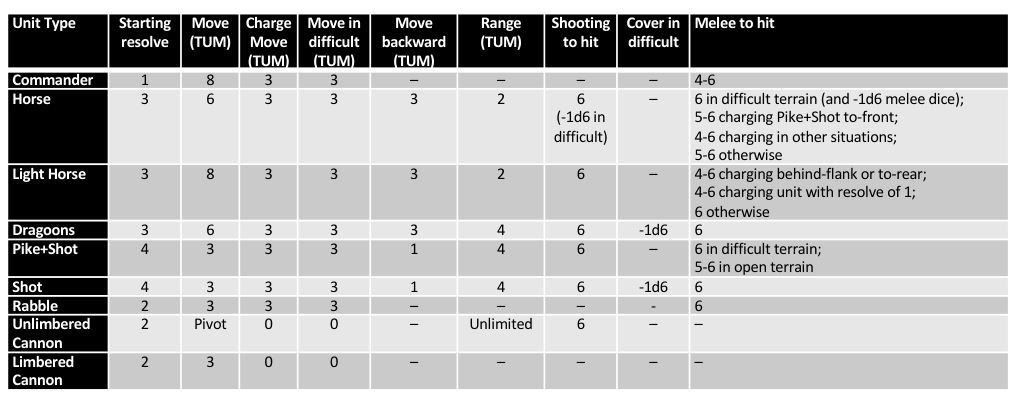
So no differentiation is made between the Dutch school of horse, Harquebusiers, 3/4 armour vs. just breast and back armour or none at all, and so on. There are some bits to introduce that sort of nuance via advanced rules, but in the core rules there’s just ‘horse’. I’m rather familiar with the period and of course I feel tickled in just the right places if rules include all that detail (as Twilight of Divine Right does in a lovely fashion for instance), but I can absolutely see how rules authors forfeit that sort of minutae in favour of swift playability. Light Horse is the only other cavalry covered, because they serve a distinct battlefield (and off-battlefield) role.
Likewise, all of infantry is covered by Pike&Shot, Dragoons, Shot (infantry armed with muskets/arquebus only) and Rabble (locals pressed into service, very raw recruits, ill-supplied infantry).
The only key statistic for each unit is Resolve. It’s bodies, morale and cohesion all rolled into one. Each hit reduces Resolve by 1, if a unit’s Resolve is reduced to 0, it is destroyed (routed) and removed from the table). In combat (shooting or melee), units roll as many dice as they have Resolve left.
The Turn
Each turn starts with a roll for initiative, the winner is the Active Player for that turn, the other being the Reactive Player. And then we proceed to the rather unique turn sequence:
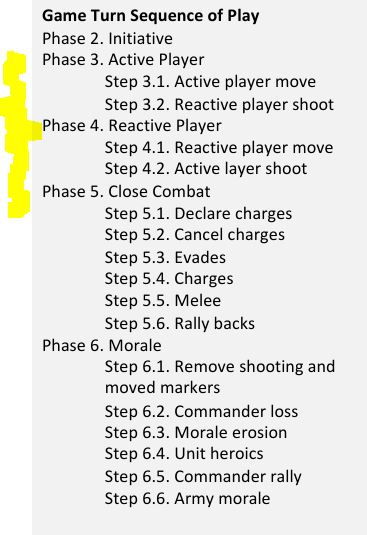
It takes a bit to get into that sequence, but after two turns it flows well.
Movement
When it’s your side’s turn to move, you just move one unit after another, up to their maximum movement rate in TUM. The author uses a TUM of 4cm, I use a TUM of 5cm, so infantry moves up to 15cm, horse up to 30cm. Movement is very clearly defined with various diagramsm and compared to other rules sets, units are rather agile.
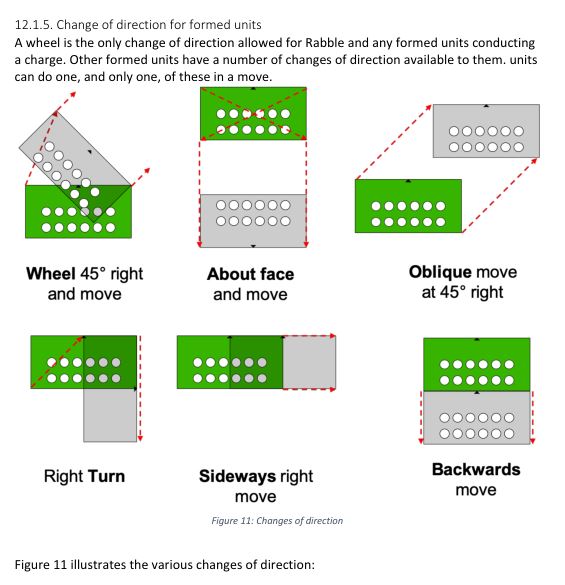
This adds to the flow of the game tremendously. We’re not used to perfectly reliable movement rates from most games we play, but it can’t be denied that it keeps things moving along swiftly.
Shooting
Shooting is pretty straightforward as well – units fire up to either 4 or 2 TUM. When firing to their front, they roll as many dice as they have Resolve. Shots to anything but straight ahead roll just 1d6, any 6s rolled are hits. Cannon work the same, but have unlimited range.
Units who moved prior may not shoot and vice versa.
Charges
After both sides have moved and shot, charges are declared via markers.
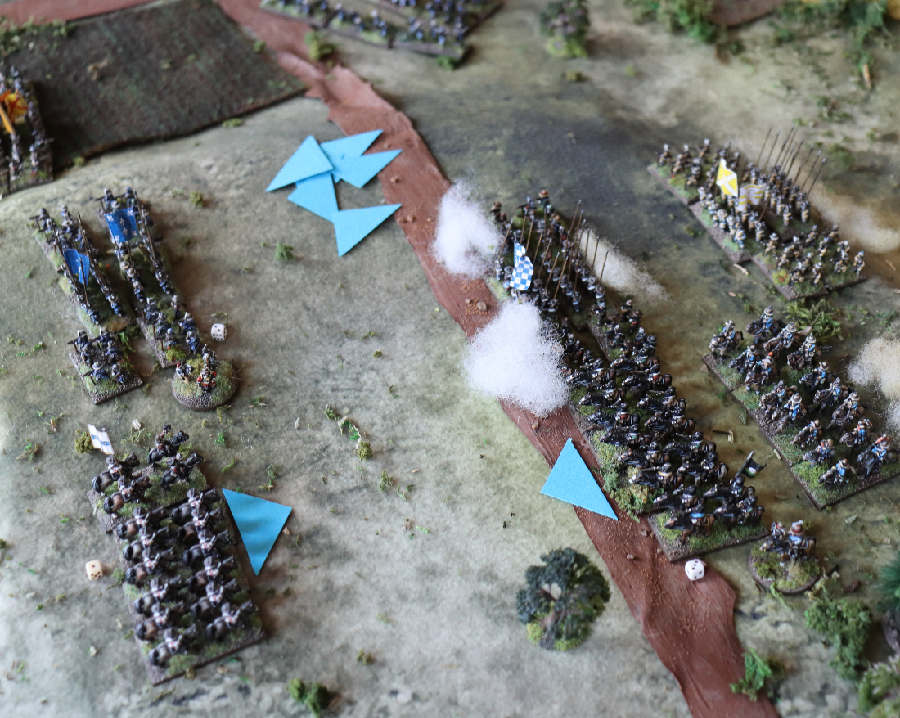
This happens simultaneously. Since units who have shot may not charge (but units who moved may), it’s usually pretty clear which units intend to charge enemy units and which don’t. Once all charges have been declared, they are worked out in a certain sequence, which may cancel other declared charges. Interesting detail: charge ranges for all units are 3 TUM.
Melee
In the ensuing close combat units roll as many dice as their current Resolve, the unit table we saw above already gives us info as which results a unit needs to hit the enemy in close combat.
There are very few additional modifiers, mainly -1d6 for units fighting infantry up-hill and most of all: -1d6 for fighting without a friendly unit to one’s back.
Each hit on a unit results in the loss of a point of Resolve, the side which inflicted more hits on the enemy wins the combat. The losing side has to Rally Back. A term which had us amused because it we’d never come across that term before in any set of wargames rules. It’s bascially a retreat. 1TUM for infantry, 3 TUM for horse.
Morale Erosion / Unit Heroics
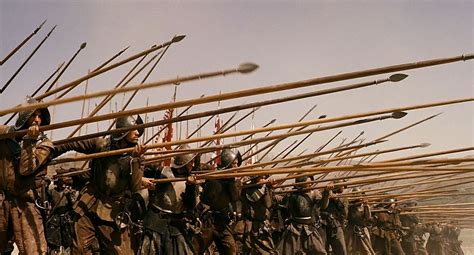
Interesting mechanisms about Tilly’s Very Bad Day. If a unit is routed (ie destroyed), the closest friendly unit within the same command or closest to the enemy unit who causded the loss loses a point of Resolve as well. In return, a unit gains back a point of Resolve if they rout an enemy unit. Which can have quite the impact. Especially in combination with…
Commanders
Commanders’ main function in the game is that units who aren’t within a certain radius around their commander have to check if they are allowed to move at all.
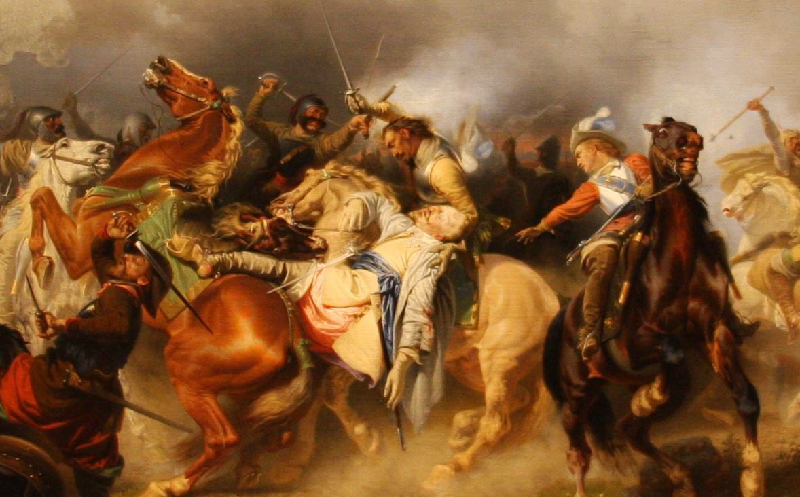
Commanders also may join units, which bolsters their melee combat by 1d6, but puts the commanders at a certain risk of being taken out each time the unit takes a Resolve hit. Classic stuff. However, the combat bonus is impressive, and on top of that, at the end of a turn a commander may rally one point of Resolve on the unit he’s attached to. A clear incentive to get commanders to the front and into the thick of it.
Winning and Losing
Of course the scenario (of which there are none in the rulebook, but lots on the blog) comes first when it comes to determining winners and losers, but the bottom line is that each army has a break point. If a unit lost 1/3rd of their units, they lose.
The Game
The Scenario
Now on to our little test game! I grabbed a scenario off of the Steven’s Balagan blog; S140 Dominant Hill.
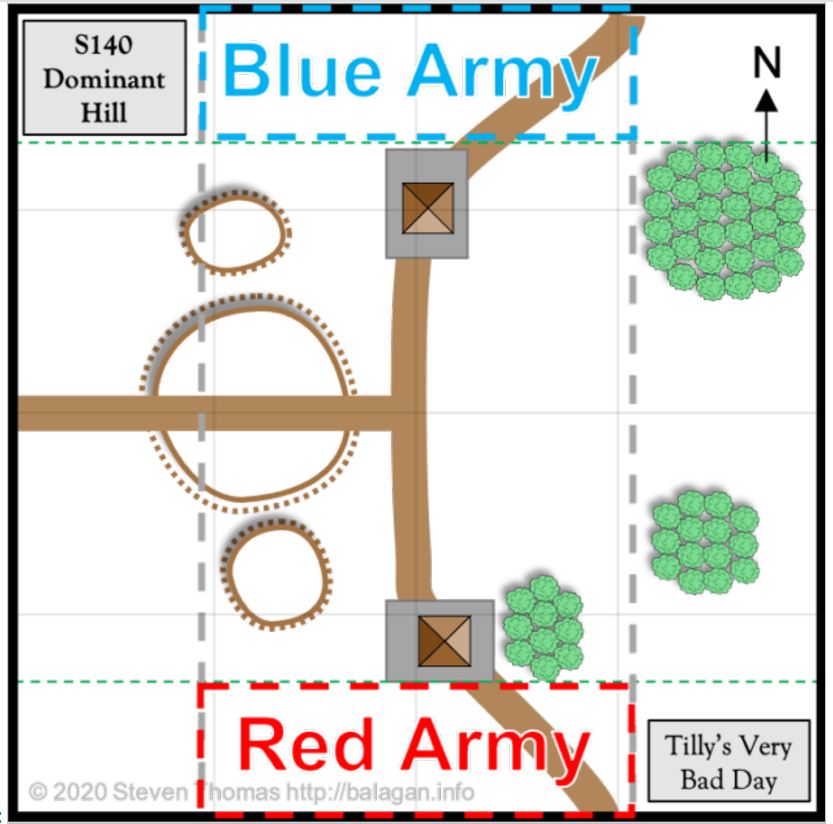
The scenario is based on Scenario 40 in Grant/Asquith’s Scenarios For All Ages, which I actually own and reviewed here over 10 years ago. I stuck to the version found on the blog, with one exception: I recuded the number of units per side from 16 to 15. Somehow I was worried the game might take too long, so i made a tiny little concession to that. For deployment, we went with the shallow version of the table. Here’s a photo of the table:
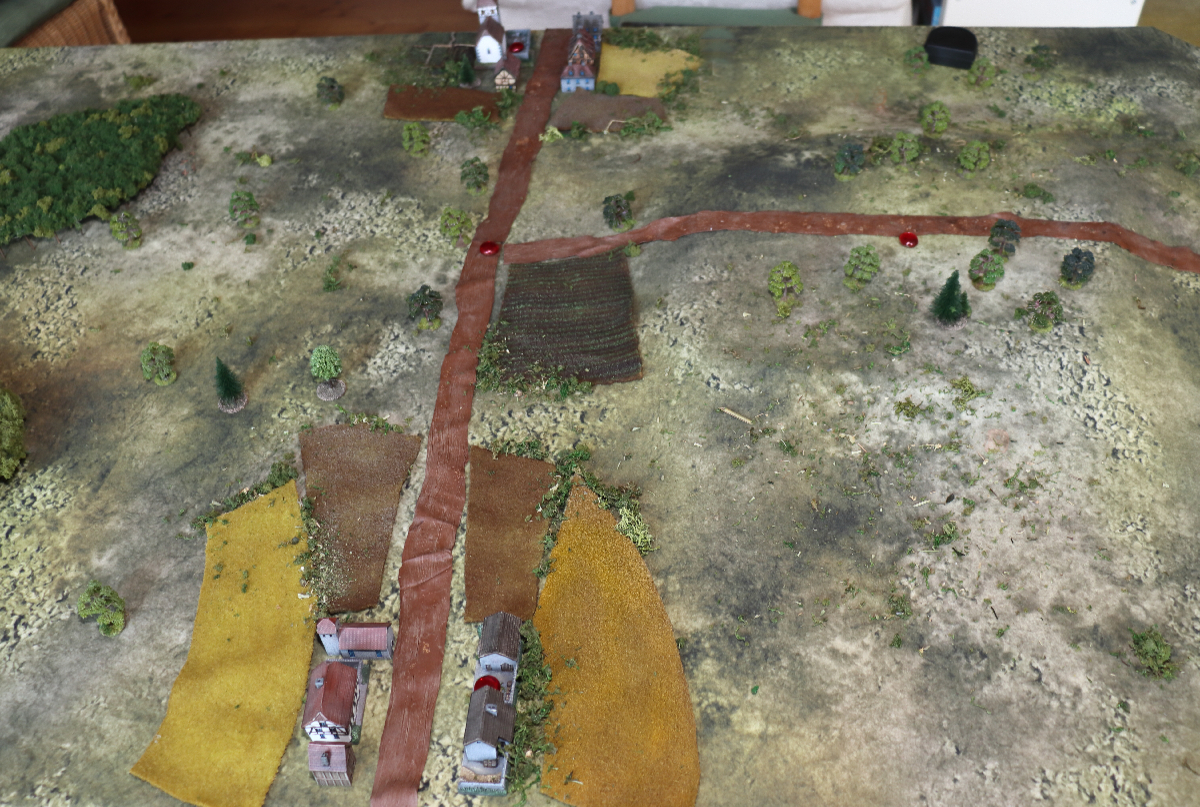
The objective is to control an important t-junction. To achieve this, an army has to control three out of the four objective points (the two villages, the t-junction itself, and the dominant hill) by the end of turn 10.
The Forces
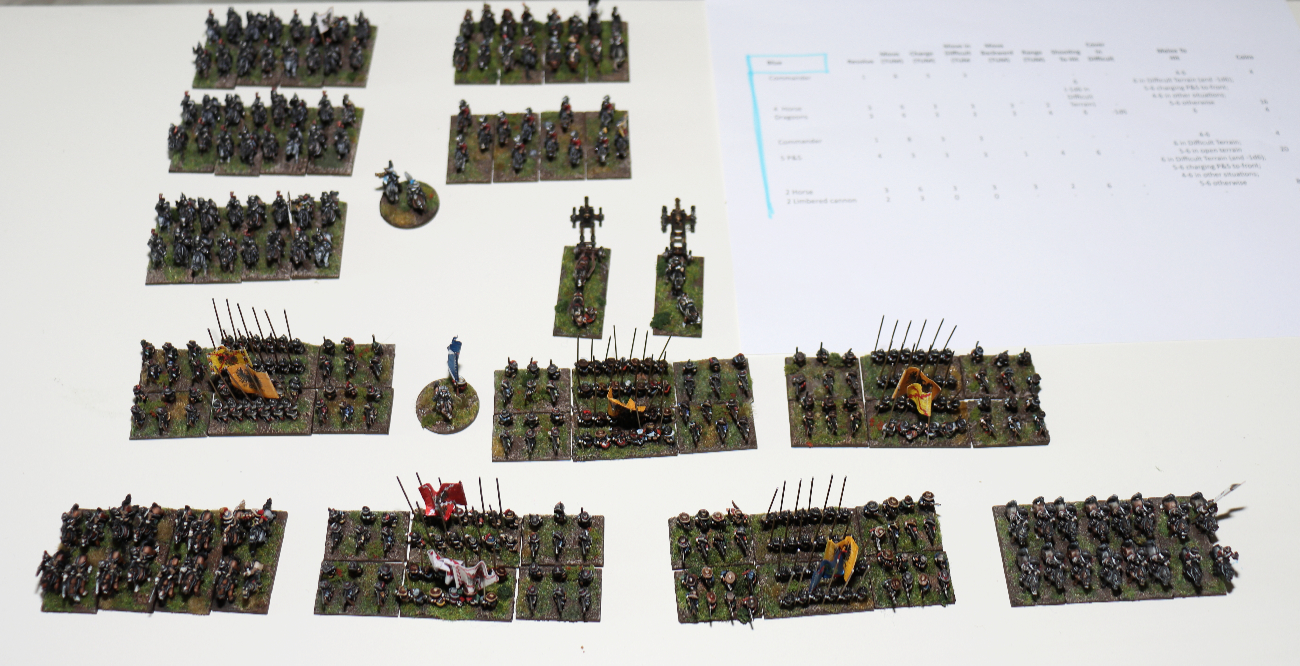
Blue (Imperialist)
Commander (Main Body)
4 Horse
Dragoons
Commander (Vanguard)
5 Pike & Shot
2 Horse
2 Cannon (Limbered)
Red (Swedish)
Commander (Vanguard)
3 Horse
Shot
Commander (Main Body)
5 Pike & Shot
Commander (Rear Guard)
3 Horse
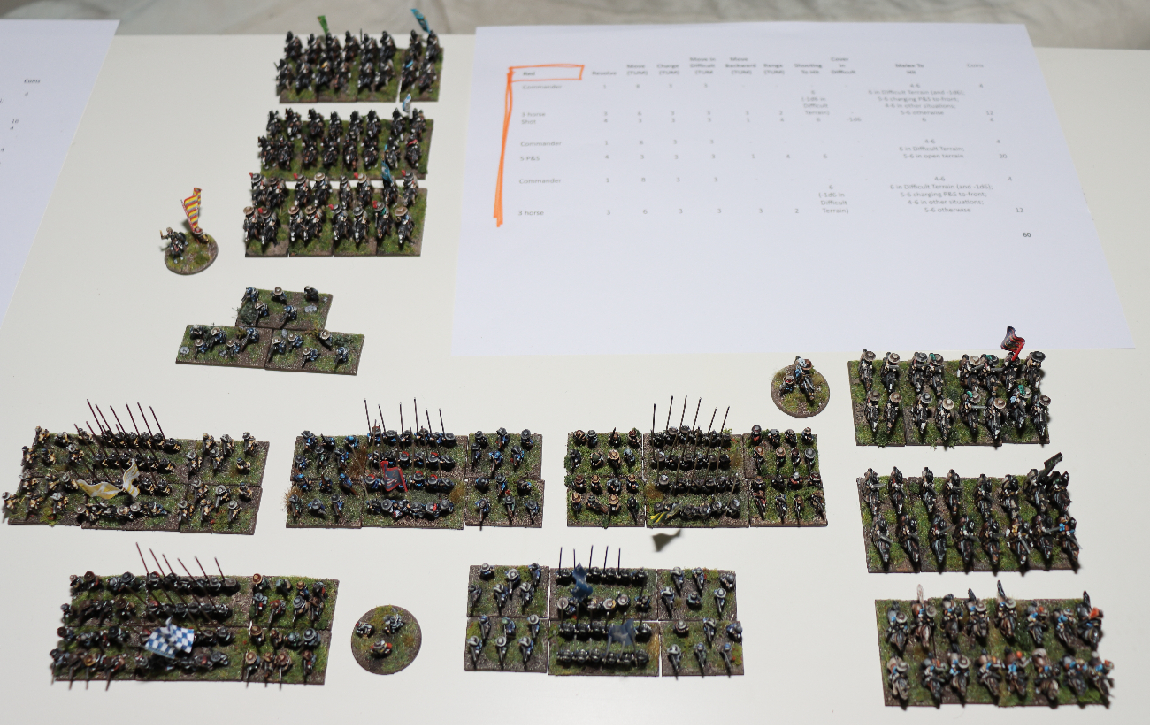
The Blue army has only two commands, whereas Red has three. Blue has a unit of Dragoons and two cannon, Red has shot (exclusively musket-armed infantry) and another commander. Before the battle, each player may choose which command would be their vanguard, moving onto the battlefield on turn#1. The army’s main body (another command) moves onto the table in turn#2 and a possible third command enters at turn#3.
I did some test rounds of combat and a bit of movement to get to grips with the rules a bit better (I try to be as prepared as possible before I subject other people to new wargames rules) before Cpt.Shandy arrived and took command of the Red army.
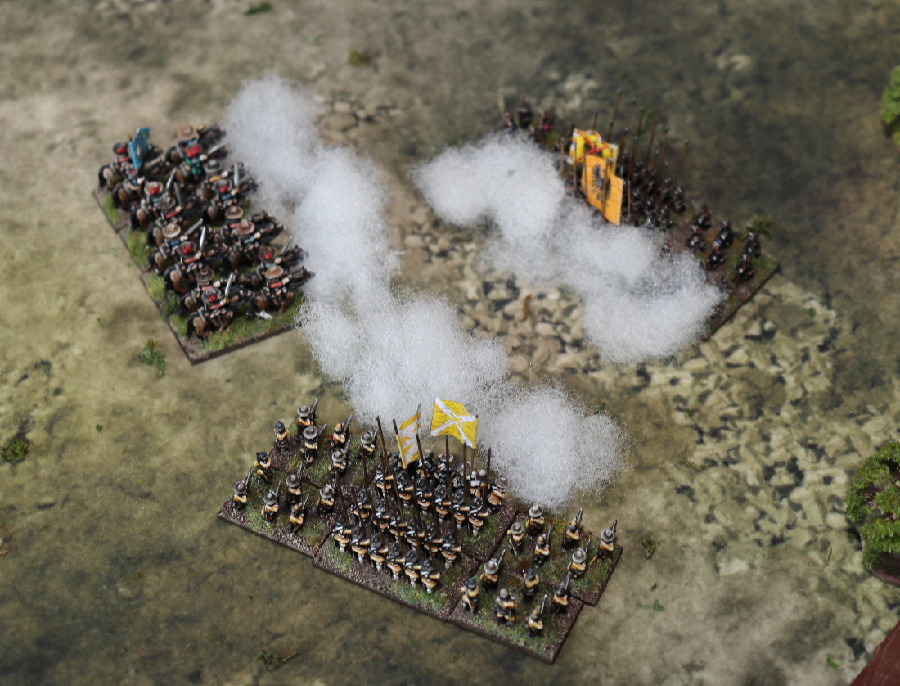
The Game
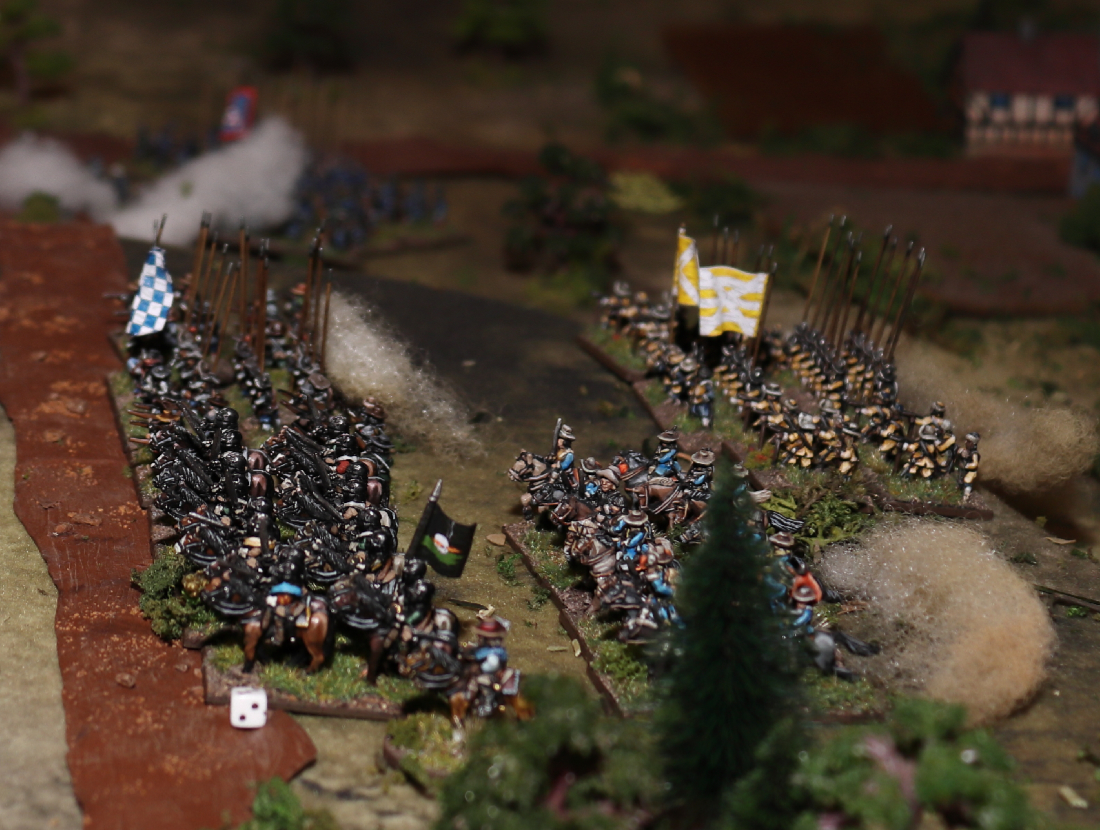
My cool plan was to take the hill swiftly with cavalry, then let infantry catch up and hold on to the thing for a bit as my cavalry punches through what looked like the enemy’s weaker flank on my left and then roll it all up. Here we can see an interesting interpretation of that, as I send my cavalry spearhead straight into enemy lines.
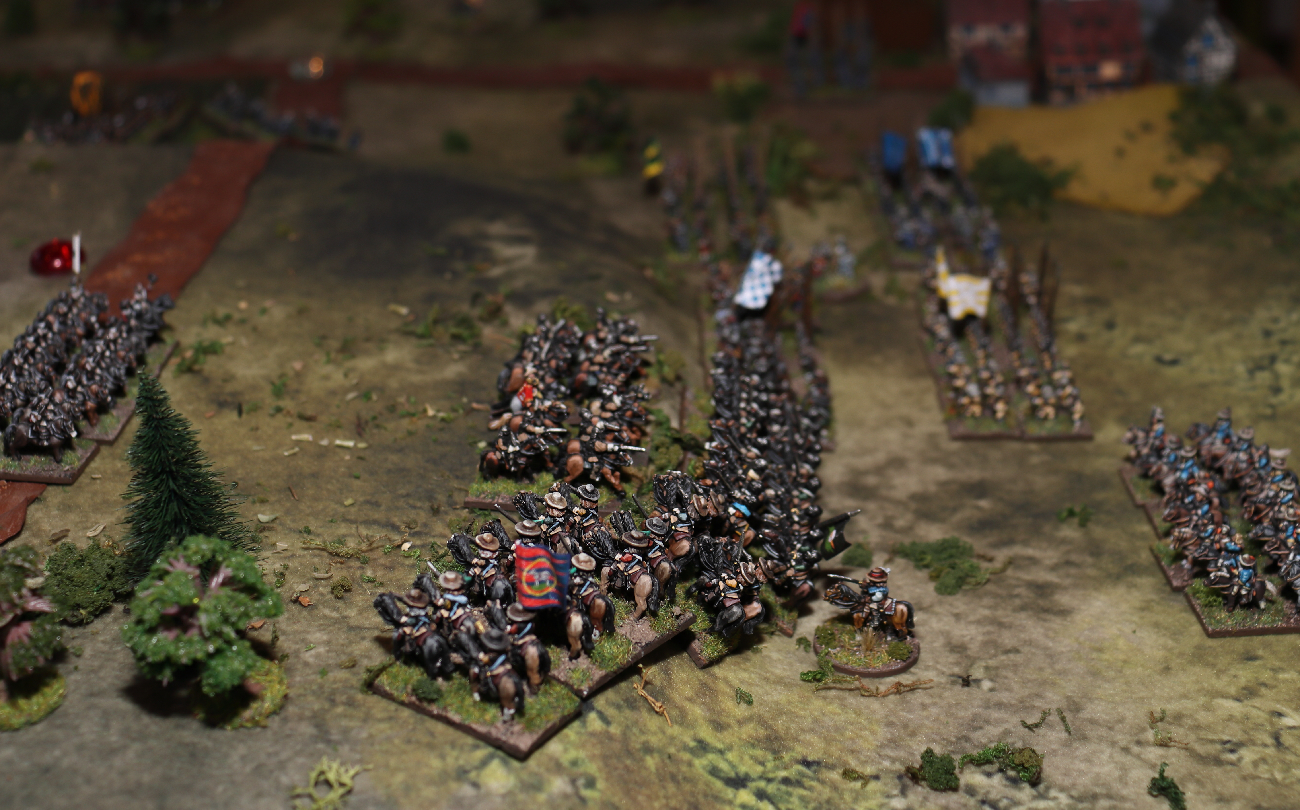
They bounce back, so it’s kind of a fighting retreat as my infantry moves up, I suppose.
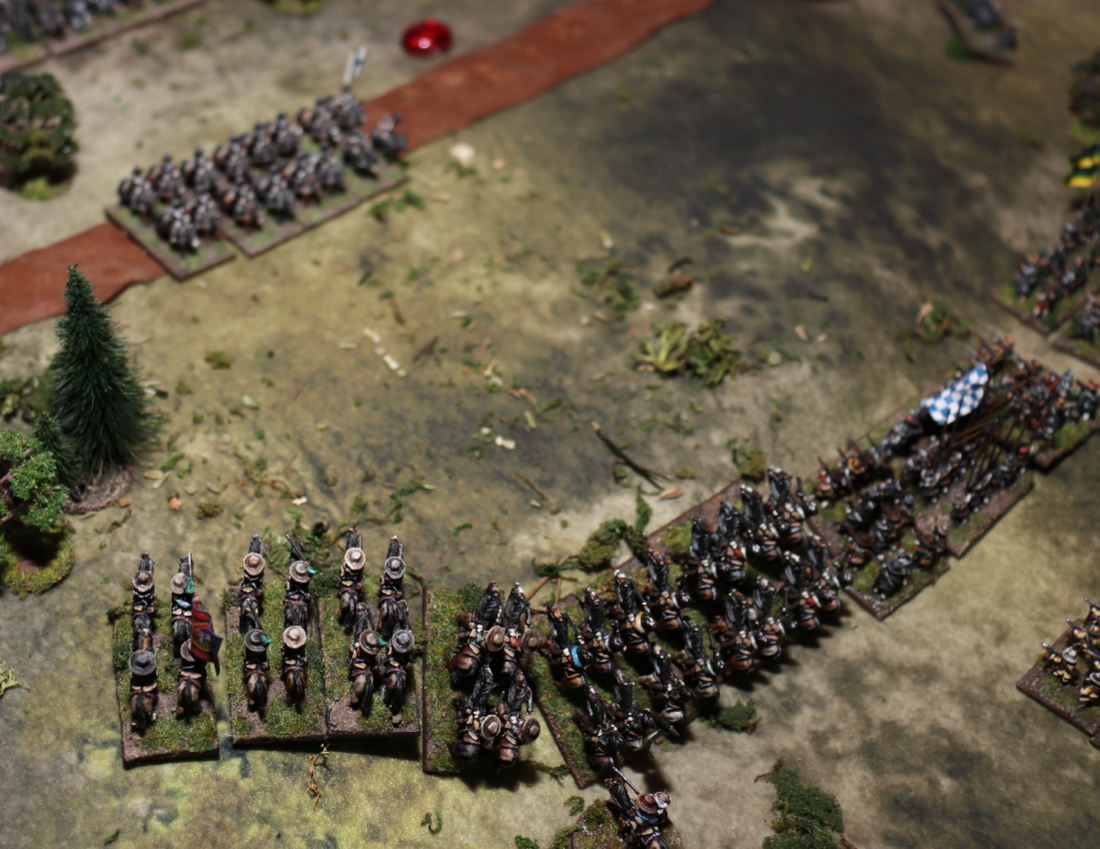
However, cpt.shandy concentrates most of his forcce (two commands, about 3 quarters of the army) at the hill flank and they advance pretty much unimpressed.
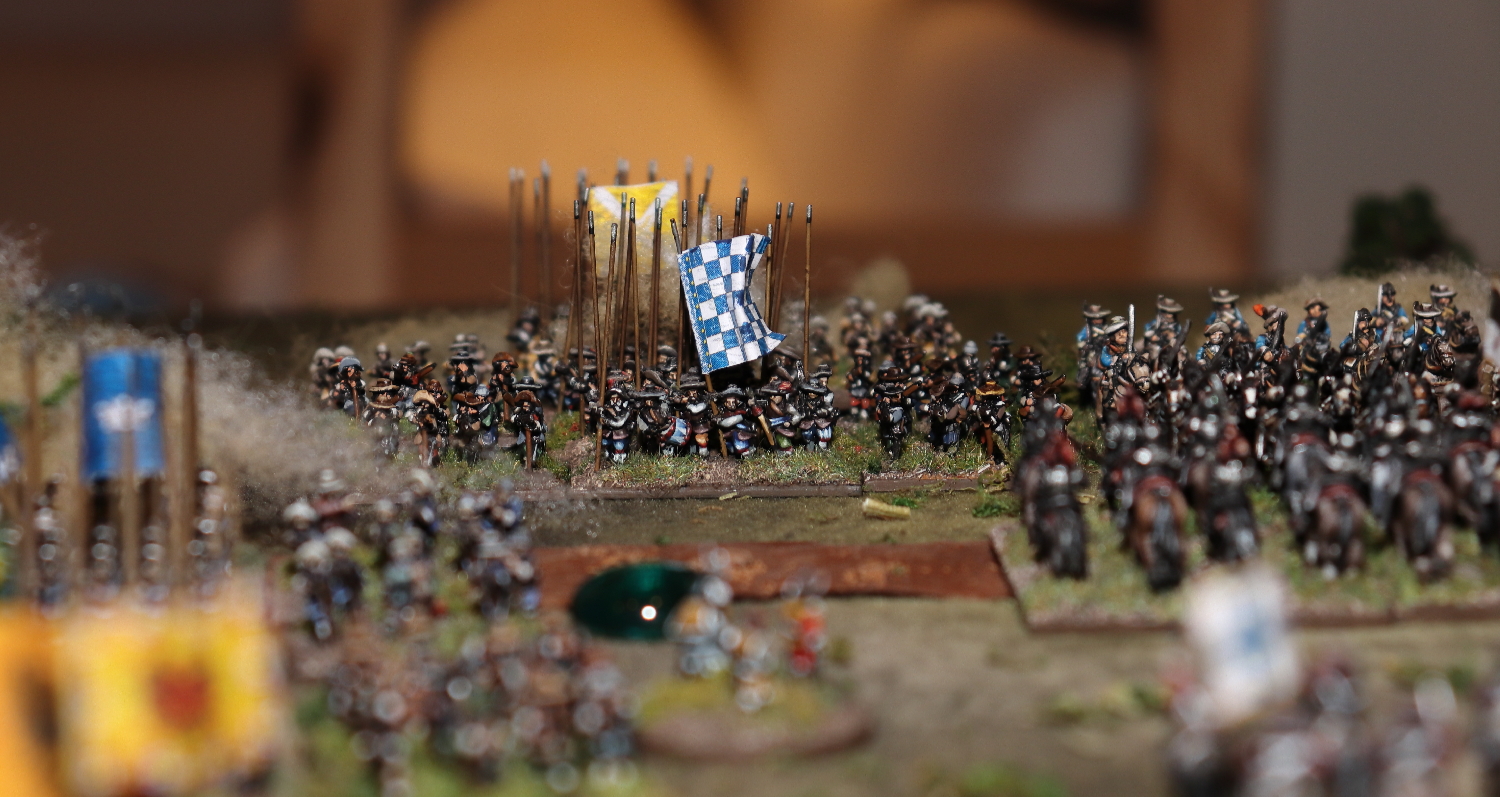
At the other flank, my cavalry proves to be less punchy than I thought and gets tangled up in an endless melee with a thin red line of enemy cavalry.
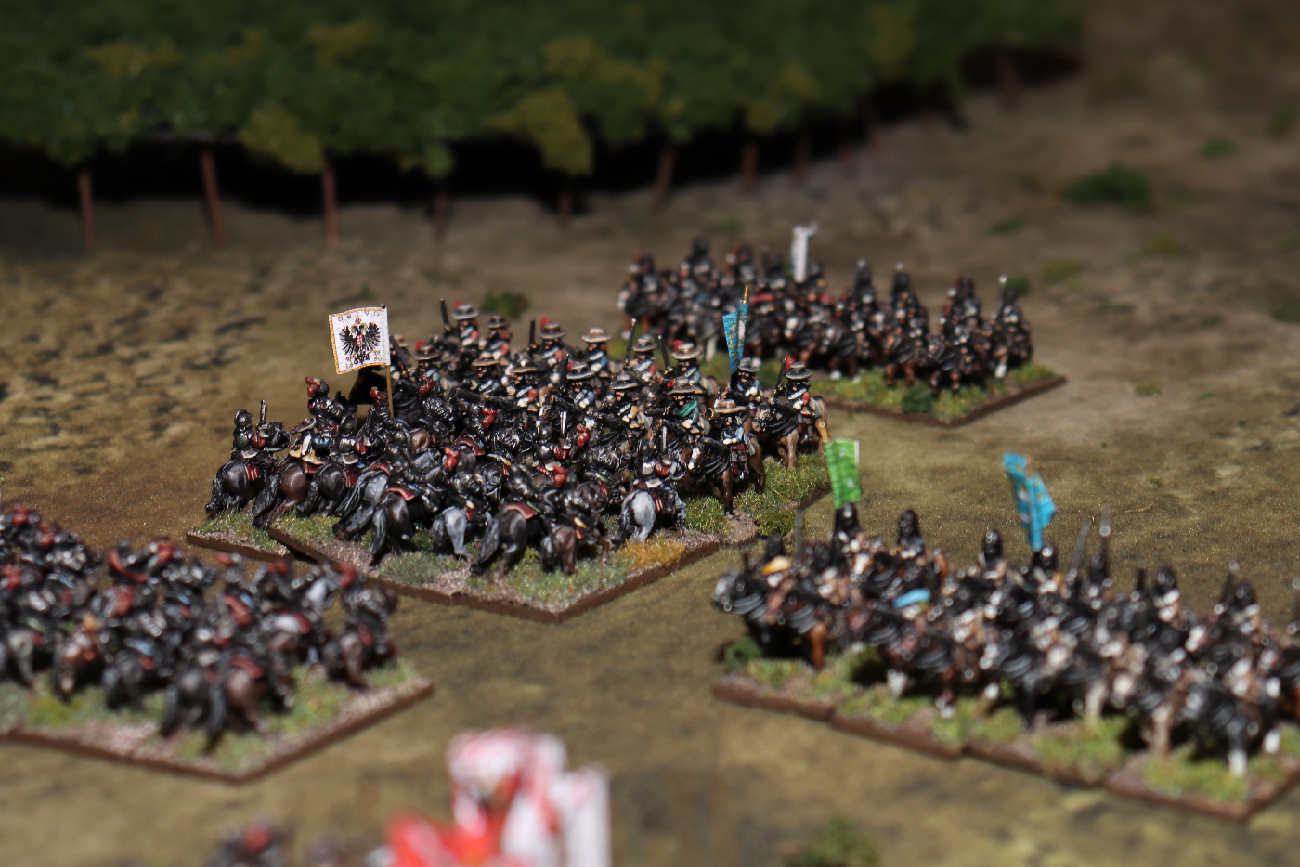
Ironically, my forces seem to be the most stable in the centre.
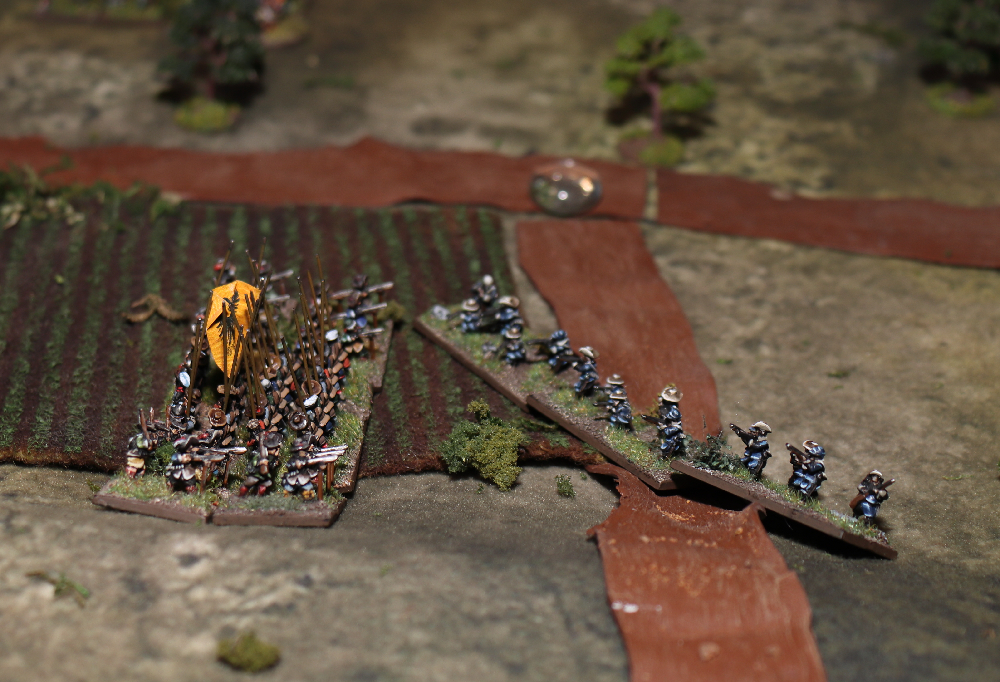
At least for a while. At turn 6, things looked pretty much like this:
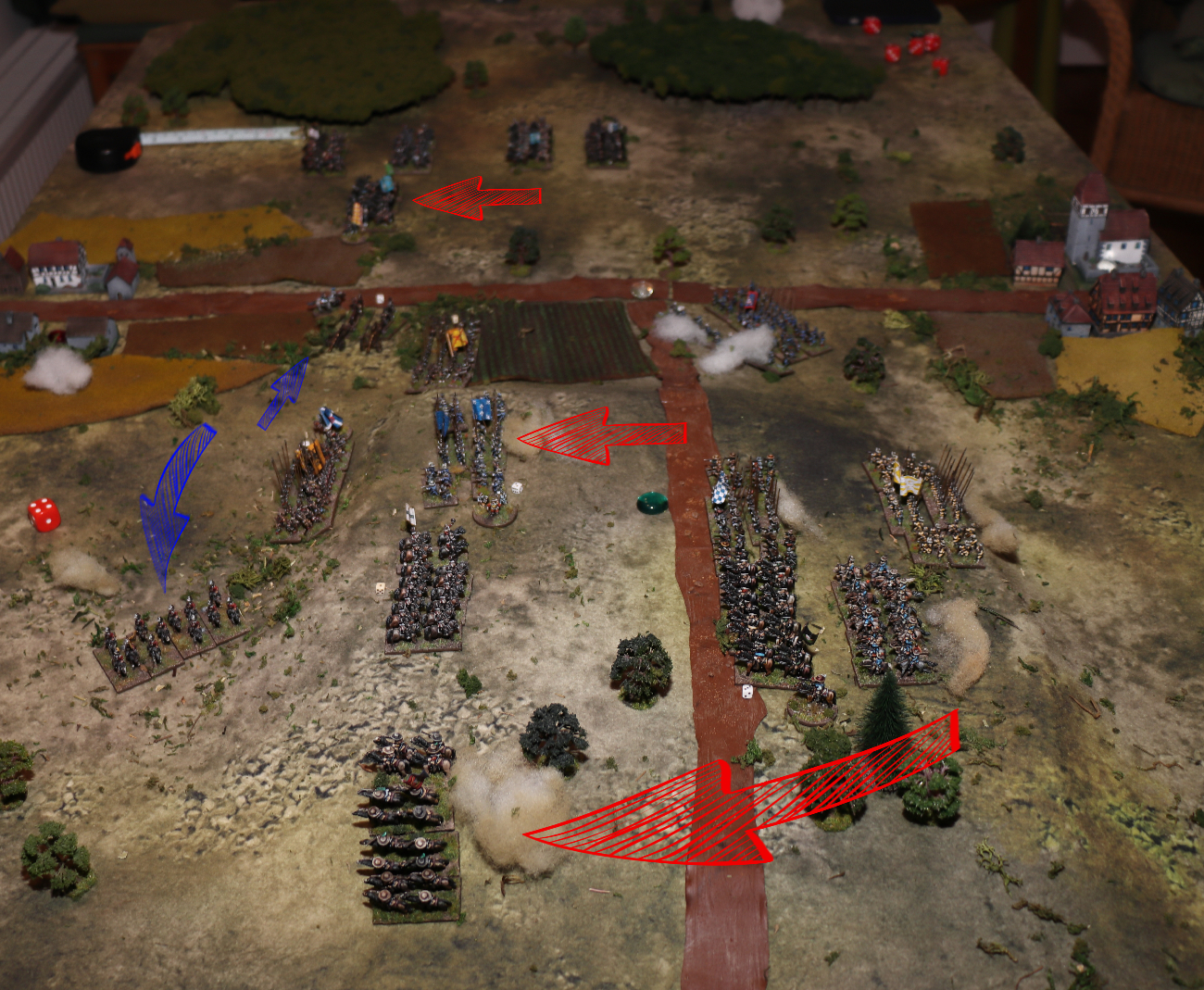
At the top in the photo, my left flank, the few enemy units proved to be incredibly tough and even routed one my my infantry! On the hill (bottom in the picture) they advance in full force and have thrown my forces amost off the hill. And even mount a flank attack! I hurry my dragoons to mount a desperate defence, as my still-limbered cannon spend the game moving from one flank to the centre in the most lumbering fashion.
Eventually, my army’s break-point is reached. My poor artillery drivers almost rout completely when learning about the loss.
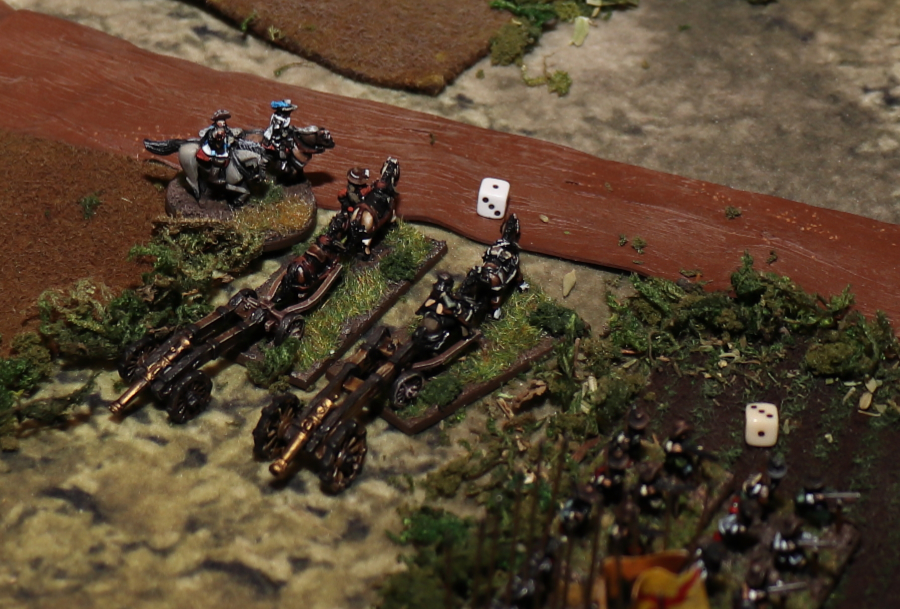
It’s a Swedish/Protestant/Red Victory!
Verdict
What I like:
.) Fast rules. The ‘fast play’ bit is no exaggeration. It’s all very clear and flows well. Units are agile, more so than one might expect for the period, but it does help the flow of the game. Our first test game took us barely 2.5 hours if I remember correctly.
.) Rear support is important. Units lose a d6 in close combat if they don’t have a friendy unit within 4 TUM to their rear (in our case that was 20cm) and no enemy unit anywhere to their own rear. Great stuff. Who doesn’t like a bit of rear support?
Any rules set which makes you want to form multiple battle lines, by subtle or unsubtle means, scores points with me. In so many wargames you want to get as many damage-dealing dice to the frontline and only put stuff behind if the table isn’t wide enough to line everything up in one neat line. At worst these units get in the way, as soon as the inevitable fleeing moves have to be done And that’s just a bit dissatisfying, considering how multiple lines/battles/whatever was the norm for hundreds of years. So I’m always happy when rules work that in.
.) Tilly’s Very Bad Day feels like a very complete, well-tested set of rules. Very clearly defined rules for game setups, for army composition, plus of course lots of scenarios and additional things on the blog.
What I like less:
.) It’s funny how alien the concept of a each unit moving a set distance each turn by now. I get why you’d have that in your game; it mainly speeds things up. Might lead to a little predictability though. (“It’s always six inches!”)
What I find noteworthy, neither positive nor negative:
.) Remarkable turn sequence; may take a bit to get used to, but once you do, it flows well.
.) Leaders add a whole lot of punch to a unit AND help keep it together automatically. If you like your leaders to lead from the front and get in the thick of it, this is for you.
Tilly’s Very Bad Day is a complete, well-tested set of swift rules for playing Thirty Years War battles (or conflicts within a similar timeframe). The rules are free to download.
I’m very glad I finally got to play these rules. Thanks to Cpt.Shandy for giving the game a go. Thanks to Mr.Thomas, who provides these rules for free, runs a top class blog and replied to an e-mail I sent him with a rules clarification question. Good game, that Tilly’s Very Bad Day. Also check out the variants of the rules, Bolivar’s Very Bad Day (covering the South American Liberation Wars 1810-1824) and the upcoming Yoshimoto’s Very Bad Day.
I hope that you enjoyed this review of Tilly’s Very Bad Day, found it interesting, enjoyed the pictures and so on. If you have any questions, comments or indeed painting/modelling commission inquiries, feel free to let me know via the comments section, the Battle Brush Studios Facebook page, instagram , Bluesky ( @battlebrushstudios.bsky.social ) or via e-mail.
Very interesting. I had heard of the rules but never saw anything done with them – thanks for this.
Cheers! 🙂 Yeah, it’s been on my to-play list for such a long time. As I may have let slip here and there, I really like the author’s blog, and I was very interested in the rules. Turns out they’re really solid for fast play things.